The Best One-Time Payment CRM (No Subscription)
Updated July 18, 2026
The math that sends people searching for a one-time payment CRM is simple: five seats on a mainstream CRM runs $1,500-6,000 every year, forever, for software whose core - contacts, pipelines, follow-ups - stopped changing years ago. Buy-once software inverts it: a license under $100, hosting you likely already pay for, and year two costs nothing.
The honest caveats belong up front: 'lifetime' claims deserve scrutiny (who ships updates, and what do they cost?), and self-hosting means updates are applied by you - which every product below reduces to a browser click. All three are ours: full source code, browser installers, lifetime updates included when bought direct. No seat counting, ever.
-
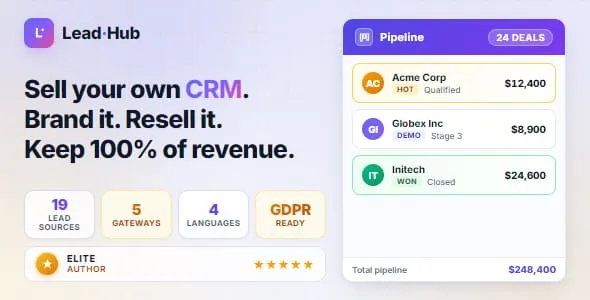
The headline act for this search: a complete, modern lead CRM - 19 capture channels, Kanban pipelines, lead scoring, email sequences, booking calendar, landing pages, team roles, GDPR tooling, optional AI including an AI SDR agent - for $29, once. Unlimited users and unlimited leads on your own server, because there is no per-seat meter to feed. It is also multi-tenant, which turns the pricing logic absurd in your favor: one $29 license can host every brand, department or client workspace you have. Updates ship regularly (it is our newest platform) and install from the browser with migrations handled.
Best for: Anyone replacing a per-seat lead CRM subscription - or consolidating several brands onto one owned install.
-
CRM for a different relationship: your users' ideas. Idea manages feedback and feature requests - submissions, voting, discussion, lifecycle from proposed to shipped - as a one-time $39 purchase, where the SaaS equivalents charge per-seat monthly for the same board. With 59 installs and years of updates it is the proven small piece of the buy-once stack: deploy it next to any product, or hand one to each client, without a new line item on anyone's budget.
Best for: Product owners who want the feedback-board subscription gone and the idea history owned.
-
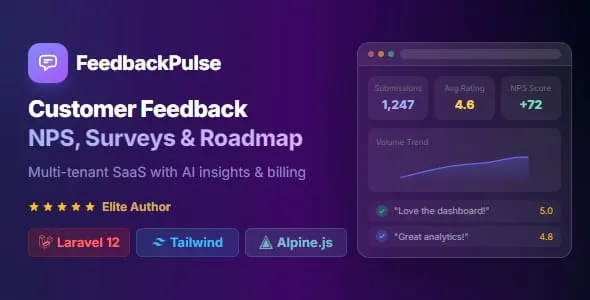
The wider feedback play at the same one-time price point: boards plus NPS surveys plus public roadmaps and changelogs, with AI capabilities included, for $29. Its SaaS architecture is the sleeper feature for buy-once shoppers: the same license that ends your feedback subscription can host workspaces for every product you run - or become a product itself if you ever charge others for access. Newest of the three; the one to pick when feedback is a program, not just a board.
Best for: Teams wanting NPS, roadmap and changelog alongside boards - all subscription-free on one license.
| Module | Platform | Standard | Rating | Best for |
|---|---|---|---|---|
| LeadHub | Laravel | $34 | ★ 4.43 | Anyone replacing a per-seat lead CRM subscription - or consolidating several brands onto one owned install. |
| Idea | Laravel | $39 | ★ 4.25 | Product owners who want the feedback-board subscription gone and the idea history owned. |
| FeedbackPulse SaaS | Laravel | $34 | - | Teams wanting NPS, roadmap and changelog alongside boards - all subscription-free on one license. |
The verdict
If the goal is 'stop renting the CRM', LeadHub is the cleanest exit we sell: a modern, AI-capable lead CRM with unlimited seats for $29 one-time - the price of a single seat-month elsewhere - and multi-tenancy that lets one license serve every brand or client you have. Round it out where subscriptions still lurk: Idea ($39) or FeedbackPulse ($29) to own the feedback layer too. Buy once, host cheap, and let the old CRM's renewal date pass unnoticed - that is the entire pitch, and the software backs it.
Questions, answered
Where is the catch with one-time payment CRMs?
Usually in one of three places: updates that quietly become paid, 'lifetime' that means the vendor's lifetime, or encrypted code that makes you hostage anyway. Our answer to each: updates are included for life when you buy direct (delivered through your account with a license key), the source is full and unencrypted so the software outlives any vendor decision, and support terms are explicit - six months on Standard licenses, lifetime on Pro.
What do I actually pay ongoing if the software is free after purchase?
Hosting (a $5-10/month PHP host runs any of these; you may already own one), and per-use costs you would pay on any CRM: SMS carrier fees, WhatsApp conversation pricing, or LLM tokens if you switch on LeadHub's AI. What disappears is the per-seat, per-month software rent - which is where 90% of a subscription CRM bill actually lives.
Is a $29 CRM actually usable, or is cheap a warning sign?
Judge the artifact, not the price tag. LeadHub ships on a current stack (Laravel 13, Filament 4), with 2FA, audit logs, HMAC-signed webhooks, GDPR tooling and a browser installer - the engineering you would expect at SaaS prices. The $29 is a distribution choice, not a quality signal: direct sales without a marketplace's 50% cut let serious software price honestly. The demo is public; twenty minutes in it settles the question better than any FAQ.
Related guides
Browse the full Themesic catalogue
Every module sold direct - lifetime updates, real developer support, and full source code. Cheaper than the marketplace, with no middleman cut.